I grew up in Germany, listening to the Brothers Grimm long before I ever saw Disney. The stories I read felt sharp and cold, like winter air on bare skin. Children got lost, wolves talked, blood sometimes flowed, and not everyone walked away smiling.
Those early tales felt darker, stranger, and more honest than the soft retellings that came later. When I first picked up a wood-burning pen, that same feeling returned. The smell of scorched wood, the slow pull of the hot tip through grain, the glow at the edge of the nib, it all reminded me of sitting in that dim kitchen, hearing about witches and wolves.
I started to see how grimm pyrography made sense: burned lines, heavy shadows, and scary moments that reveal truth and beauty at the same time. Now I teach this blend of story and symbol in wood-burning art, so beginners can step into their own dark woods with a hot pen in hand.
Why Grimm Fairy Tales Belong in Pyrography Art
The original Grimm tales sit close to the bone. They talk about hunger, fear, cleverness, and luck in simple images, not polished speeches. Pyrography does something similar. It turns a plain board into a story with nothing but heat, time, and pressure.
For beginners, that mix is perfect. You do not need fancy technique to burn a path into a forest or a lone tower on a hill. You only need a few clear shapes, a little shading, and a feeling for the mood. The story does the rest.
Dark stories, dark lines that’s how Grimm tales fit the burn
Pyrography is all about contrast. Pale wood, dark burn. Soft glow, sharp line. Grimm tales live in that same split between light and dark.
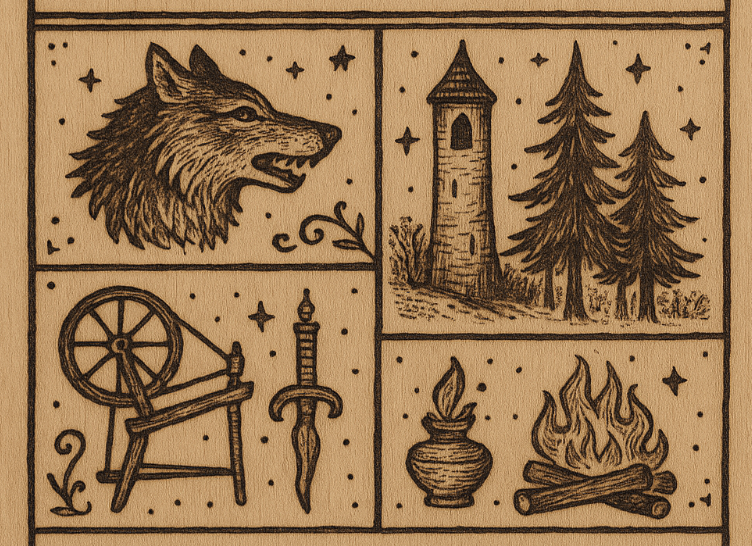
I picture Little Red Riding Hood’s forest as a tangle of thin black trunks, the path a lighter band snaking through them. In Rapunzel, the tower becomes a simple vertical shape, stone marked with rough cross-hatching, a single open window like an eye. Sleeping Beauty can show up as a quiet spinning wheel, its spokes darker where fire has kissed them, a ring of thorns curling around the base.
Simple shapes, strong shadows, and suddenly the board whispers a story you already know.
Lessons that are not cute but real life inside old tales
When I was a child, nobody softened those stories for me. People stole. Parents failed. Children got scared and still had to act. Add that I grew up in foster care since I was two, and I learned early that life is not always neat or sweet.
Those hard lessons sit inside the wood when I burn. Danger, choice, courage, hunger, greed, they are not abstract ideas. They are wolves at the edge of the village, breadcrumbs on the path, a locked door at the top of the stairs. When I burn these images, I feel more grounded, not more afraid. The honesty calms me.
For beginner wood-burners, that depth can change everything. Instead of “just a pretty board,” the piece becomes a quiet mirror. A small forest scene might hold a memory of getting lost and finding your way. A wolf’s head might carry an old fear you are finally ready to look at. The lines are simple, but the feeling runs deep.
Turning Wolves, Witches, and Forests into Wood-Burned Stories
Over time, I started to shape this mix of story and fire into a path for others. I call it Grimm Pyrography, both an approach and the name of my year-long program. It is made for beginner wood-burning artists who want more than random practice boards.
In this work, every project grows from a tale. Wolves, witches, forests, towers, hearths, each month we meet them in wood, guided prompts, and simple patterns. You do not have to invent everything from scratch. You get a story to lean on, and plenty of space to make it your own.
Powerful Grimm symbols that belong on your wood panels
Some symbols from the Grimm stories love to live in wood. They are clear, bold, and easy to burn, even on a small piece. A few of my favorites are:
- The wolf: the threat at the edge, and the shadow side inside us. Beginners can start with a side-profile wolf head, or just a paw print beside a hint of trees on a bookmark.
- The forest: the unknown, confusion, and also the place of change. A simple path between tall trunks on a small plaque already tells so much.
- The spinning wheel: work, fate, and the threads of a life. On an ornament, you can burn the circle, a few spokes, and a line of thread linking to a small pile of straw.
- The hearth: safety, home, and everyday magic. A tiny wall, a firebox, and a kettle above it can turn a scrap of wood into a kitchen charm.
- The tower: isolation, power, and the long climb out. A narrow tower on a pendant or keychain creates a quiet reminder of times you felt alone.
In my grimm pyrography journey, we go deeper into these symbols with guides and prompts, but even simple versions carry a strong charge.
From mini burns to hero projects, that’s how a story grows on wood
I love to start small. A single ornament with a wolf. A bookmark with a path into the trees. A tiny round disk with a spinning wheel in the center. These mini burns give you space to practice pressure, shading, and control without fear.
From there, the story can grow. One day you look at your collection of small pieces and realize you are ready for a larger “hero” project. A forest box with a wolf on the lid. A hearth panel for your kitchen. A tall plaque with a climbing tower and a trail of hair or vines.
In Grimm Pyrography, I guide that growth with 12 hero projects and 12 small projects, plus weekly Prompts. We play with textures like fur, stone, foliage, and glow. Repeating symbols across pieces starts to feel like chapters of one long story written in burn marks.
Why a year-long Grimm Pyrography journey keeps your fire alive
Working with one theme for a whole year does something kind to the heart. Grimm tales form a strong container. You are never staring at a blank board, asking, “What now?” Instead, you return to wolves, forests, towers, and hearths again and again, each time with a new mood or memory.
Inside our private creative circle, beginners share their burns without pressure. Guided videos, printable patterns, and a techniques library keep you from getting stuck. Weekly Prompts land like small sparks, asking you to burn a simple symbol, a texture, or a short scene.
When you join, you receive the Grimm Symbolism Mini Guide, five core symbols, their hidden meanings, and tiny prompts you can try right away. I like to call it a first torch in the dark woods, just bright enough to show you where your feet might go next. Imagine how your work could shift in a year if you kept returning to these same symbols, letting your own story slowly fuse with the old tales in wood and fire.
Bringing Your Own Story Into the Dark Woods
At some point, it stops being about my wolves and my forests, and starts being about yours. That is where the magic really happens.
You can bring Grimm ideas into your pyrography on any scale. One coaster, one ornament, one scrap of wood by your stove can hold an entire chapter of your life.
Simple ways beginners can start with Grimm-inspired burns
If you are new to wood burning, keep it simple and clear. You might try:
- A single symbol, like a wolf paw print by a bare tree.
- A small scene, just a path leading into tall trunks, nothing else.
- A household object, like a kettle by a hearth or a broom leaning on a wall.
- A silhouette, such as a tower on a hill with one small window.
- A simple border, thorns or vines curling around the edge of a box lid.
Pick one tale from childhood, or one that still scares or moves you. Pull out a single symbol and burn only that. You do not have to draw it freehand. You can trace patterns, use stencils, or outline in pencil first. The point is not perfection. The point is to let the story touch the wood.
Let the wood remember, why these dark tales stay with us
When we burn Grimm symbols into wood, we give our own memories a place to live. The grain holds the heat, then cools, but the mark remains.
Those early tales taught me that fear, grief, courage, and cleverness all belong in one life. There is room for the child alone in the forest and the adult who finds their way home. For me, grimm pyrography is a way of honoring that rough truth. I let the stories that raised me sit beside the stories I am still living.
I invite you to think of one lesson from a fairy tale that still shapes how you see the world. Now picture that lesson as a small burned image on your wall or desk, quiet and steady, reminding you who you are when the woods get dark.
Grimm fairy tales belong in pyrography because they share the same bones: light and shadow, fear and courage, plain wood and burned truth. When I pick up my hot pen, it feels like stepping into the dark woods with a tiny ember in my hand.
Grimm pyrography is my invitation to walk there with me, one symbol at a time. You do not need a huge project or perfect skill to begin. You only need one story, one small piece of wood, and the courage to make a mark.
Let your first wolf, forest path, or tower be imperfect and honest. The fire will remember, and so will you.